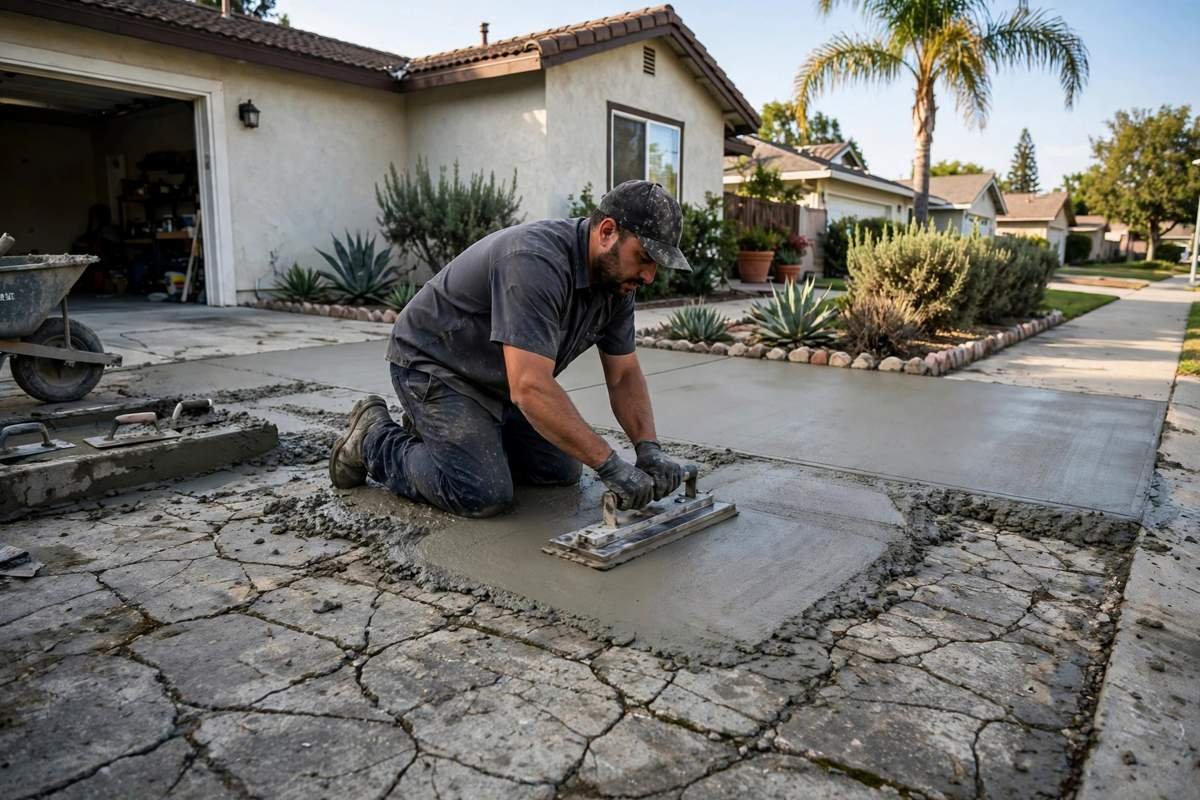
A driveway takes more wear than almost any other part of a home. Cars, trucks, foot traffic, sun, rain, and temperature changes all work on the surface day after day. Over time, even a well-built driveway can develop cracks, flaking, or slabs that no longer sit level. When that happens, homeowners in Northridge and Granada Hills usually ask: can it be repaired, resurfaced, or replaced?
The answer depends on the type and extent of the damage. For concrete driveway repair in Northridge, CA, a proper site inspection is the starting point — it shows whether the problem is limited to the surface or whether the base, drainage, or roots underneath are part of the cause.
Common Driveway Problems in the San Fernando Valley
Driveways in the San Fernando Valley face conditions that can shorten their life without a proper base and drainage: heat dries out the surface, rain finds its way into small cracks, and nearby trees send roots under slabs.
Cracks, Spalling, and Uneven Slabs
Cracks are the most common driveway problem. Hairline cracks are thin surface lines that may look worse than they are. Wider cracks, cracks across a slab, and cracks that keep growing usually point to a deeper issue, such as movement in the base or slab. Small cracks can let water in, widening the crack and weakening the support beneath it.
Spalling is the flaking or peeling of the top surface, caused by water, salt or chemicals, or a weak finish. A driveway with spalling may still be sound underneath, but the surface becomes rough and uneven. Widespread or deep spalling, especially with cracking, can mean the slab itself is deteriorating.
When one section sits higher or lower than the next, it creates a trip hazard, a place for water to pool, and a rough ride. Uneven slabs are often caused by soil settling, erosion under the slab, poor base compaction, or tree roots pushing the concrete upward. A slab that has sunk or lifted significantly is rarely fixed by a surface treatment, because the problem is underneath it.
Drainage Issues and Tree Roots
Drainage issues are a common cause of driveway damage. When water does not drain away, it can wash out the base, soften the soil, and cause slabs to settle or crack. Poor drainage can also send water toward the home.
Tree roots are another frequent cause: they grow under slabs, lift them, and crack them from below. A driveway near large trees needs careful inspection, because cutting roots without a plan can harm the tree.
Repair vs. Resurfacing vs. Full Replacement
Repair, resurfacing, and replacement are three different answers to driveway damage, and the right one depends on what the inspection finds.
When Repair or Resurfacing Can Work
Hairline surface cracks and minor spalling can often be repaired or resurfaced. Repair means cleaning and filling cracks, patching small areas, and sealing the surface. Resurfacing applies a new thin layer to restore a smooth appearance and protect the surface. These options work best when the slab is still sound, sits level, drains properly, and the damage is limited to the surface.
When Replacement Is Usually the Better Choice
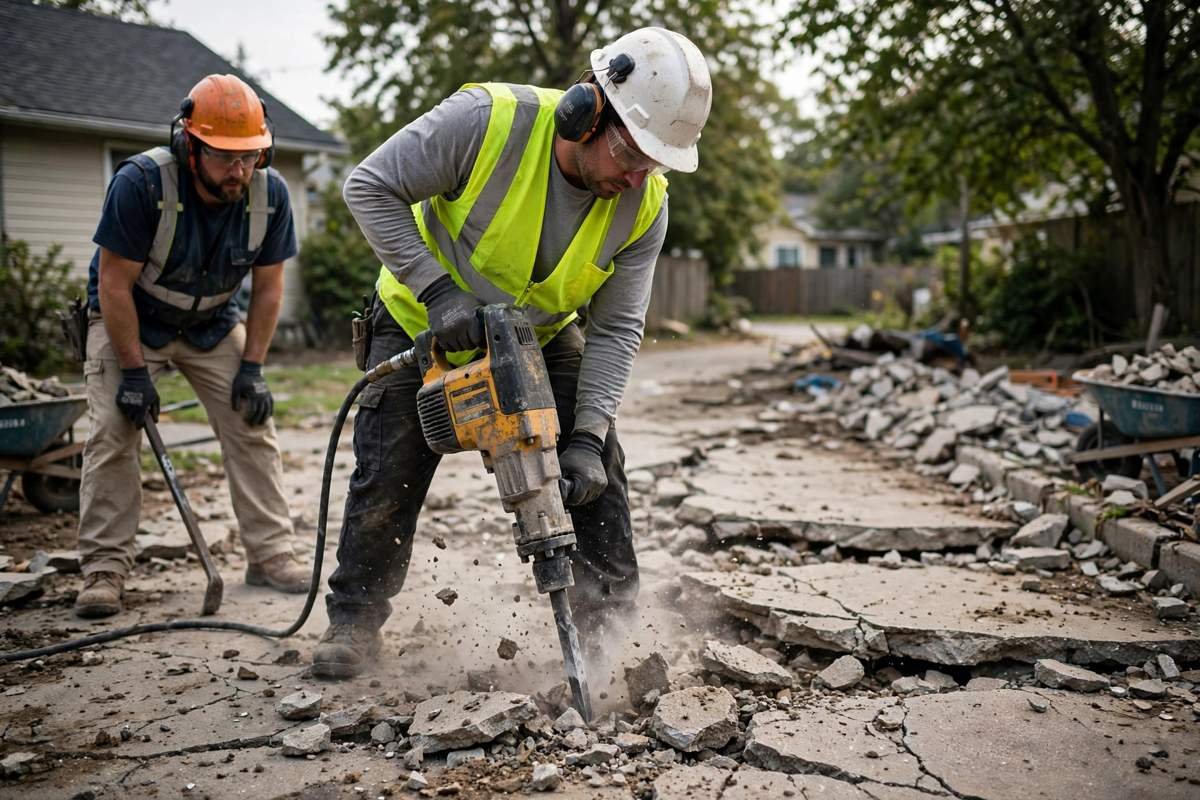
Wide or deep cracks, sinking or uneven slabs, drainage failure, and root damage usually mean replacement. Here the slab or the ground beneath it has failed, and a surface treatment will not fix it. Replacement involves tear-out and haul-away, a prepared base, reinforcement, and a new pour. It is a bigger job, but it addresses the underlying cause rather than covering it up.
A site inspection checks cracks, drainage, and roots before deciding on repair, resurfacing, or replacement. The contractor looks at crack width and depth, whether slabs have moved, how water flows, and whether tree roots are involved. Without that inspection, a homeowner risks paying for a repair that will not last, or replacing a driveway that could have been saved.
What Full Driveway Replacement Involves
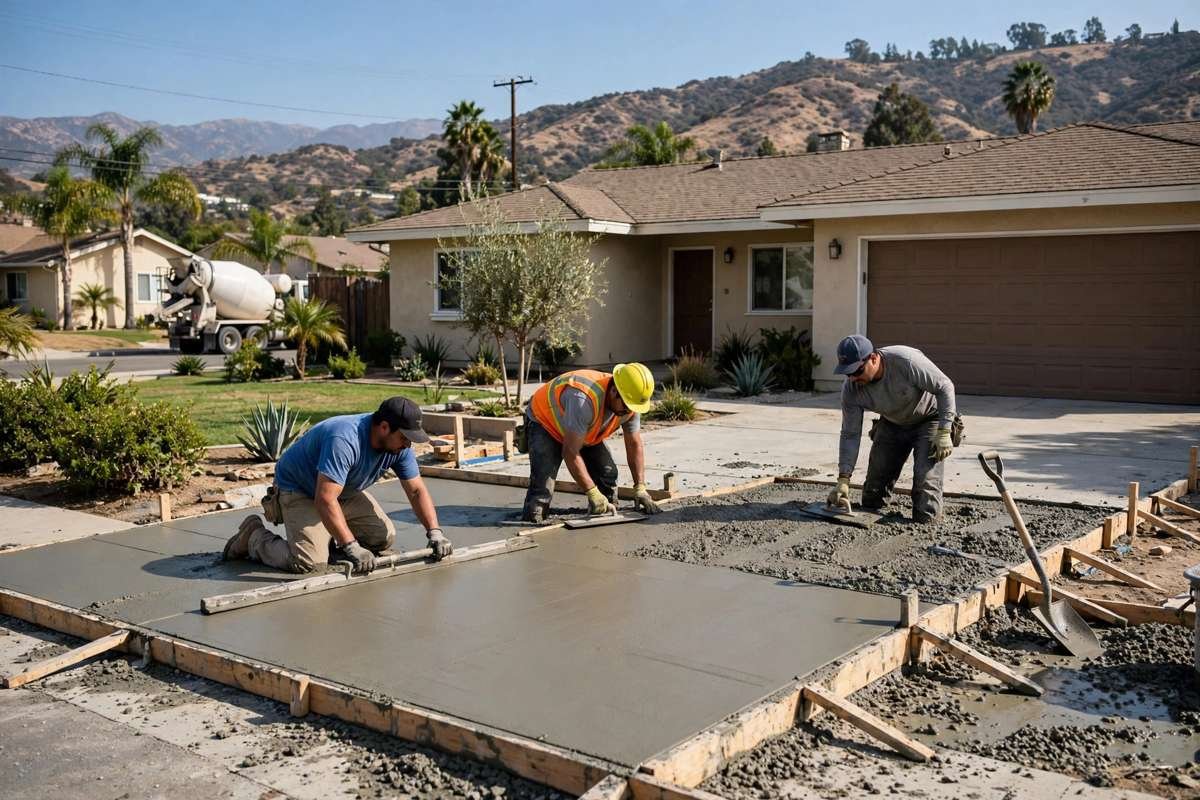
When replacement is the right choice, the work follows a clear sequence. First, the old concrete is torn out and hauled away. Next, a compacted aggregate base is prepared to support the new slab evenly. Reinforcement, such as rebar or wire mesh, helps resist cracking. Then the new concrete is poured, leveled, and finished — broom, exposed aggregate, or stamped, as the homeowner chooses. After curing, a final inspection confirms the surface, finish, and drainage are as planned.
What Affects the Cost of Driveway Repair or Replacement?
The cost of driveway work depends on the size of the driveway, removal work, site preparation, finish, and reinforcement. A small repair and a full replacement of a large driveway with a decorative finish are very different jobs. Difficult access, drainage corrections, root removal, and base repairs can also add to the scope. An accurate estimate comes from a site inspection.
Choosing a Contractor for Concrete Driveway Repair in Northridge, CA
For concrete driveway repair in Northridge, CA, look for a contractor who inspects the driveway before recommending repair, resurfacing, or replacement, and explains the reasons clearly, including the base, drainage, and reinforcement to be used.
Wall Brothers Construction provides residential and commercial concrete services across the San Fernando Valley, including Northridge and Granada Hills, with free estimates, and can assess whether a driveway is a candidate for repair or needs full replacement.
Frequently Asked Questions
Can hairline cracks in a driveway be repaired?
Yes, hairline surface cracks can often be repaired by cleaning, filling, and sealing them. They should still be checked, because cracks can let water into the base and cause larger problems.
What is the difference between resurfacing and replacing a driveway?
Resurfacing applies a new layer over a slab that is still level and sound, restoring its appearance and protecting the surface. Replacement removes the old concrete entirely and builds a new driveway from the base up, and is needed when the slab has sunk, cracked deeply, or failed because of drainage or roots.
How do I know if my driveway needs replacement instead of repair?
Wide or deep cracks, sinking or uneven slabs, drainage failure, and root damage usually mean replacement. A site inspection checking cracks, drainage, and roots is the best way to decide.
How long must a new driveway cure before I can drive on it?
New concrete must cure before vehicle use so it can gain strength. The time depends on the mix, weather, and the pour, and the contractor should confirm when it is safe to drive on it.
Conclusion
Cracks, spalling, and uneven slabs do not have to mean the end of a driveway, but they do need an honest assessment. Hairline cracks and minor surface damage can often be repaired or resurfaced, while wide cracks, sinking slabs, drainage failure, and root damage usually call for replacement on a proper base. If your driveway in Northridge, Granada Hills, or elsewhere in the San Fernando Valley is showing signs of damage, contact Wall Brothers Construction at 818-421-7217 for a free estimate.