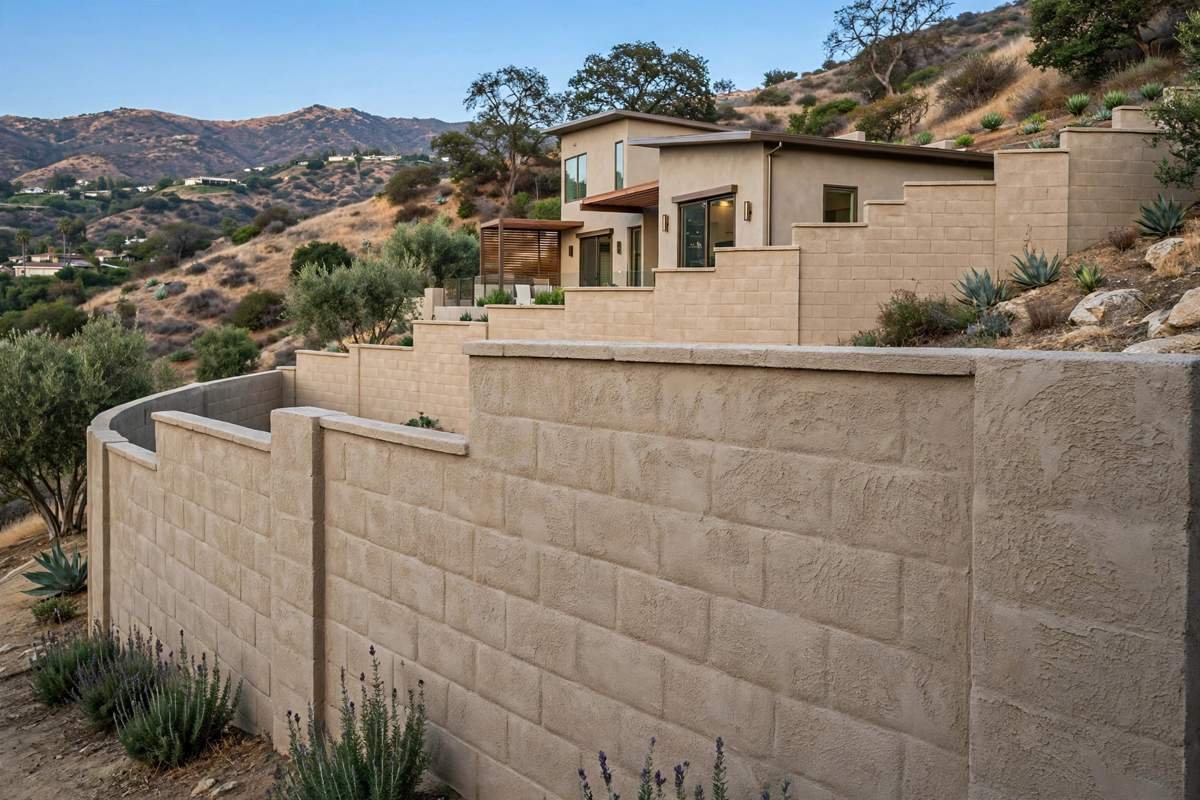
A block wall does more than mark a boundary. For homes in Calabasas and Hidden Hills, it can provide privacy, add security, define the garden, and, on sloped land, help support and retain the ground behind it. A well-built masonry wall is a lasting part of the property.
Block wall contractors in Calabasas, CA work with a range of wall types, heights, and finishes. The right choice depends on the site, the purpose of the wall, and local regulations.
Types of Block Walls
Block walls come in several forms, each with a different appearance. Understanding the options helps homeowners choose a wall that suits their home and neighbourhood.
CMU and Cinder Block
Concrete masonry units, often called CMU or cinder block, are the most common choice. They are strong, durable, and widely available. A CMU wall can be left with its block pattern showing, or finished with stucco for a smoother look.
Slump Stone and Split Face Block
Slump stone has a soft, irregular shape that gives a wall a more rustic, natural appearance. Split face block has a rough, textured face that adds visual interest. Both suit homeowners who want a wall less plain than standard block, and both can be finished with caps and coatings.
What a Block Wall Can Do
A block wall serves several purposes at once, and the design should reflect the one that matters most.
Privacy and Security
A wall of sufficient height blocks the view into a garden or yard, giving the household privacy from neighbours and passers-by. A solid masonry wall is also harder to climb or pass through than a light fence, and, combined with a gate, it helps control access to the yard and the home.
Hillside Support
On sloped land, a block wall can act as a retaining wall, holding back soil and helping to level part of the garden. Hillside properties in the San Fernando Valley often need this support, and the wall must be designed for the loads it will carry.
The Block Wall Construction Process
Building a block wall is a step-by-step process, and the strength of the finished wall depends on getting the early stages right.
Site Inspection
The first step is a site inspection. The contractor checks the property line, access, and the requirements for the wall, including its purpose, height, and length. Confirming the boundary first is essential for a wall on or near a property line, where local regulations, easements, and neighbour considerations may apply.
Excavation and Footing
A trench is dug for the footing, the concrete base that supports the wall and spreads its weight over the ground. Its size and depth depend on the height of the wall, the soil, and the loads involved. A wall built on a weak footing is likely to crack or lean.
Reinforcement with Rebar and Grout
Reinforcement is placed inside the wall to give it strength. Steel rebar runs vertically and horizontally through the blocks, and grout is poured into the block cores to bind the reinforcement and the blocks together. This is particularly important for taller walls and for walls that retain soil on a hillside.
Block Installation
The blocks are laid in courses, levelled and aligned as the wall rises. Mortar joints hold the blocks in place, and the work is checked regularly for level and plumb so the finished wall is straight and true. Openings for gates are left at the planned positions.
Caps and Finishes
Once the blocks are in place, caps are fitted to the top of the wall, and the chosen finish is applied. Stucco can be used as a finish on suitable masonry walls, giving a smooth surface that can be painted. The finished wall is then inspected, and the work area is cleaned up.
What Affects the Cost of a Block Wall?
The cost per linear foot depends on length and height, block type, footing, reinforcement, finishes such as stucco and caps, and site conditions such as difficult access, slopes, or removing an old wall or fence. A taller wall, a decorative block, or a hillside site costs more per foot. A reliable estimate comes from an inspection of the specific site in Calabasas or Hidden Hills.
Permits and Property Lines
Permit needs vary by height, location, and local regulations. Taller walls, and walls on a hillside or near a property line, generally face more requirements. Property-line walls deserve particular care: local regulations, easements, and neighbour considerations can affect where a wall may be built and how high it may be. Confirm the boundary first, and discuss the plan with neighbours where appropriate, to avoid disputes and costly changes later.
Frequently Asked Questions
How much does a block wall cost per linear foot in Calabasas?
The cost per linear foot depends on length and height, block type, footing, reinforcement, finishes, and site conditions. A taller wall, a decorative block, or a hillside site will cost more per foot than a low, straightforward wall. An on-site inspection gives the most accurate estimate.
Do I need a permit for a block wall?
Permit needs vary by height, location, and local regulations. Taller walls and walls on hillsides or near property lines are more likely to need a permit. Confirm the requirements for your property before work begins.
How long does it take to build a block wall?
It depends on the length and height of the wall, the site conditions, and the finish. A short garden wall may take only a few days, while a long or tall wall, or one that retains a hillside, takes longer. Weather and curing time also affect the schedule.
Can a block wall be built on a property line?
It may be possible, but property-line walls involve local regulations, easements, and neighbour considerations. Confirm the boundary first and check what applies to your property before building.
Is a block wall better than a wood fence?
It depends on what matters most. A block wall offers durability, privacy, and weather resistance, and it needs little maintenance. A wood fence may have a lower initial cost and a different appearance, but it needs more ongoing care. Many homeowners choose block where privacy and long-term durability are the priorities.
Conclusion
Compared with a wood fence, a block wall offers greater durability, privacy, and weather resistance, while wood may have a lower initial cost and a different appearance. A block wall is a lasting addition to a home in Calabasas, Hidden Hills, and across the San Fernando Valley, providing privacy, security, property definition, and hillside support in a single structure. Its quality depends on careful planning: confirming the boundary, choosing the right block type and height, building a sound footing, reinforcing with rebar and grout, and finishing with caps and stucco where suitable.
Planning a new block wall? Contact Wall Brothers Construction for a free estimate. Our team can inspect your property, explain your options, and plan a masonry wall that fits your home and your land.